Virtual reality
CS-444
Media
Virtual Reality
the course plans 5 weeks of VR hands-on with coding work (--2h/week) from weeks 3 to 9 of the semester. For this reason, the 1h of exercise from 12h to 13h is used for teaching for the first 2 weeks whereas there will be less time of lecture during the weeks 4 to 9 period.
The paper study is an individual work starting on week2 with a deadline on week6.
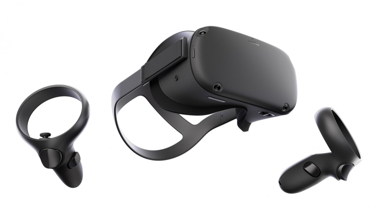
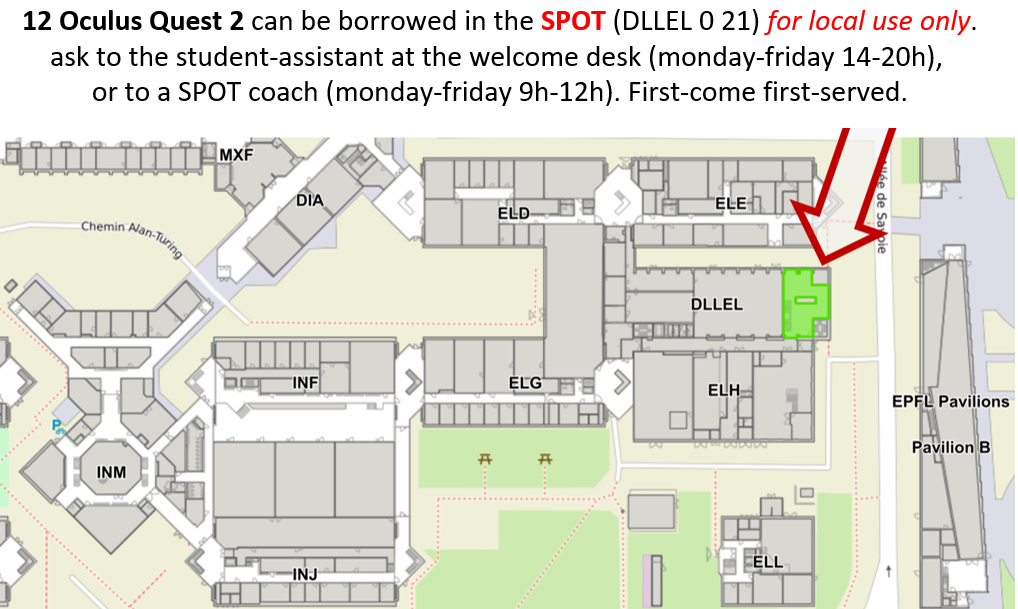
The project is written in C# on UNITY3D ; it starts on week 3 where groups of 3 persons are formed and can retrieve their Oculus Quest HMD(s) on a first-come first-served basis; we only have 19 of them (half Oculus Quest and half Quest2) for spring 2025. The project pitch is planned on week 5 after the Oculus Quest hands-on. The project ends on week 13.
GRADING SCHEME (spring 2025)
- The paper study grade has a weight of 15% ; you will know your grade before the final theoretical oral (see below)
- The project assignment has a weight of 50% that includes a project oral evaluation conducted in presential (with individual questions on the code).
- The individual theoretical oral control during week 14 has a weight of 35% (the duration is 15 minutes / closed books / the first third of the oral exam is presenting a summary of the paper study and the rest consists of questions on related VR theoretical concepts)) . The theoretical oral exam will be conducted in presential during the whole week 14.
DETAILED SCHEDULE for spring 2025
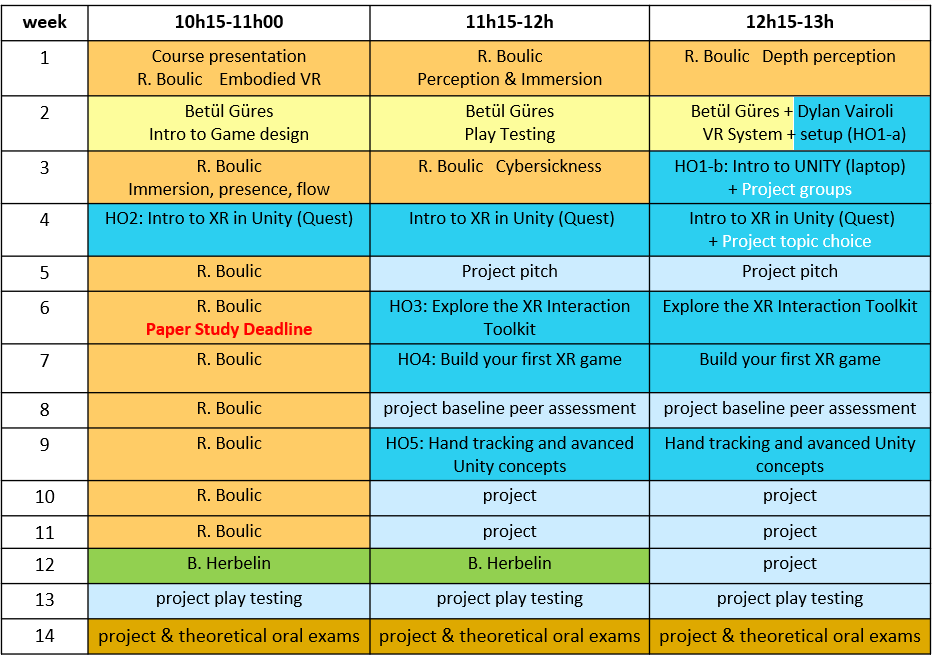
Feb. 17th [1h course presentation and embodied VR concepts +2h about perception]
10h15 :R. Boulic : Course structure including a brief overview of the 5 hands-on demos, the paper study and the project
R. Boulic : VR as "Embodied Interaction"
11h15: R. Boulic 1h: Feeding human senses through "Immersion"
12h15: R. Boulic 1h: Depth Perception
- Slides R. Boulic "course organization" [17.02.2025] (File)
- video mediaspace: organization [17.02.2025] (URL)
- Slides R. Boulic "VR as embodied interactions" [unchanged for 2023-24] (File)
- video mediaspace : embodied VR [17.02.2025] (URL)
- Is "Immersion" only about vision ? (Text and media area)
- Slides "key human senses / immersion" [2023-24] (File)
- video mediaspace [2024-25] (URL)
- Slides "Depth perception" [2023-24] (File)
- video mediaspace [2024-25] (URL)
- Information about the paper study assignment: (Text and media area)
- Paper study specifications for spring 2025 (goto topic6 for uploading & plagiarism dectection tool) (File)
- Example of paper study [Slater Presence 2004] (File)
- Paper list proposed for the Paper study [Spring 2025] (File)
- The Paper Study choice closes on March 25th [Spring 2025] (Group choice)
February 24th : Project background material [2h20 teaching by Betül Güres; 0h20 by Dylan Vairoli] from now on, without webinar ; recorded video from previous year will be visible after the course period
Betül Güres: Game: Play testing
Betül Güres : VR systems and project presentation together with Dylan Vairoli
- Betül Güres: Introduction to Game Design_2025 (File)
- video switchTube : Game design [spring 2022] (URL)
- Betül Güres :GDD example (File)
- video switchTube : Play testing [spring 2022] (URL)
- Betül Güres : VR Systems & project overview [2025] (File)
- The VR Project Guidelines (URL)
- VR Project Group Formation [2024-25] (Group choice)
- HO1: Setup and introduction to Unity (File)
- Hands-On & Project additional information (URL)
March 4th [2h teaching and 1h UNITY intro]
R. Boulic 1h: How much Immersion is necessary ? what is he difference between Immersion and Presence ? and Flow ?
R. Boulic 1h: Cybersickness
Hands-on HO1 Week3
- Slides "Immersion, Presence and Flow" [ 04.03.2024] (File)
- video switchTube (from previous year) (URL)
- Slides "Cybersickness" [ok for 2023-24 ] (File)
- video switchTube part1: perceptual conflict theory (from previous year) (URL)
- video switchTube part2: Rest frame theory and "motion to photon" latency (from previous year) (URL)
- video switchTube part3: measuring cybersickness, design guidelines (from previous year) (URL)
- Week5 VR Project 3 min pitch time slot choice (check with your group before answering) (Choice)
March 10th [3h TP with own laptop and HMDs]
Hands-on HO2 Week4
March 17th [1h teaching/ 2h pitch]
- Pitch timing time slots : both initial choice and shifted slot (File)
- Starting to present the 3D interaction techniques ... (Text and media area)
- Slides "Basic 3D interaction techniques: Magic vs Naturalism (today ONLY up to the section on NAVIGATION/Naturalistic techniques)" (File)
- video on SwitchTube : Naturalism vs magic / the Navigation task (partly) [2021] (URL)
March 25 th [1h teaching / 2h TP]
R. Boulic 1h : Basic 3D interaction techniques: Magic vs Naturalism (part 4)
The paper study is due this week ; you can upload it with Turnitin below :
- Slides "Basic 3D interaction techniques: other 3DUI components" Last Part with minor update [2025] (File)
- Video switchTube on "magic" navigation techniques (20 min) (URL)
- Video switchTube on the Selection and the Manipulation components (25 min) [2021] (URL)
- video switchTube on other components of 3D interaction(42 min) [2021] (URL)
April 8th [1h teaching, the initially planned 2h TP]
R. Boulic 1h : Haptic interfaces (part1 & 2)
Hands-on HO4 week7
- Slides Haptic interfaces Part 1/3 [2019-20] (File)
- video switchTube 1/3 :haptic display characteristics (URL)
- Slides Haptic interfaces Part 2/3 [2019-20] (File)
- video switchTube 2/3 : range of haptic display / design guidelines (URL)
April 15 th [1h teaching / 2h peer assessment of basic interactions]
R. Boulic : Haptic Interfaces (part3) / The perception and Action (Part 1/2)
- Slides Haptic Interfaces (Part 3/3) [2019-20] (File)
- video switchTube 3/3 : virtual coupling and pseudo-haptics (URL)
- Slides "Perception and Action" (Part 1/2) [2023_24] (File)
- video switchTube 1/2 :brain maps and body sheme (URL)
- The purpose of this session is to assess the desig... (Text and media area)
- Basic-interaction peer assessment criteria grid (File)
April 14 th [45 min]
R. Boulic : The perception and action (end)
- Slides "Perception and Action" (Part 2/2) [2019_20] (File)
- Video switchTube 2/2 : perception of biological movement (URL)
April 28th [45 min]
- Slides "What makes a Virtual Human alive?" (Part 1/3) [2023_24] (File)
- Video switchTube 1/3 : avatar and virtual human agents: the uncanny valley (URL)
- Slides "What makes a Virtual Human alive?" (Part 2/3) [2024_25] (File)
- Video switchTube 2/3 : off-line productions vs perception of real-time animation (URL)
R. Boulic: Motion capture (short overview added to the slides of Part 2/3)
What makes a virtual human alive (Part 3/3)
- Slides "What makes a Virtual Human alive?" (Part 3/3) [2023_24] (File)
- Video switchTube 3/3 (29 min) (URL)
May 12 th [2h teaching] invited lecture from Dr Bruno Herbelin (Senior researcher in EPFL Cognitive Neuroscience Laboratory)
B. Herbelin: Immersive Virtual Reality, Telepresence and their cognitive foundation / Embodied Virtual Reality (course material from B Herbelin from EPFL-LNCO)
The slides from Bruno Herbelin have been made visible below ; the video recording are not up to date but can be partially useful as the slides do not include any video.
- Slides Embodiment impact and application (May 12th 2025) (File)
- Video switchTube of Immersive Virtual Reality, Telepresence and their cognitive foundation (old recording) (URL)
- Slides Virtual Reality, Telepresence and their cognitive foundations (May 8th 2023) (File)
- video switchTube Embodied Virtual Reality (old recording) (URL)
May 19th : Playtesting 10h-13h before uploading final version on Sunday 25th midnight
This
assessment session helps to gather some playtesting feedback from
other players that are not members of your group. It will help to refine
some aspects before the final upload of the project later in the week. Today, you can continue to finalize your project but we highly recommend that you take advantage of the presence of other groups' members to invite them to test your game (even partially) before/after the assigned student-assistant visits you.
For the test by the student-assistant, it is on a first-ready, first-tested basis ; so
meet them at the beginning of the session to discuss your preferred
time range for the test of your game. If you didn't proactively set any
test time range the student-assistants will decide themselves when they
visit you before 13h.
May 26th: as the 3h available time won't be sufficient, the Final Individual Oral Exams for theory will be spread during May 26-28th in presential in INJ 141. A time slot selection tool will be made visible here on May 19th, after the paper study grades are provided.
The Project Group Presentation will be held on the 26th of May in presential in INF220.
- Project evaluation: Whole group presentationThese ... (Text and media area)
- VR Project pitch time slot choice May 26th (check with your group before answering) (Choice)
- Project evaluation: Individual smoke detection ses... (Text and media area)
- Final theoretical oral exam protocol in INJ 141 :D... (Text and media area)
- Week14 15min THEORETICAL oral exam in INJ 141: single time slot choice within May 26th-28th (Choice)
- Paper study grade (max15pts) [20.05.2025] (File)
- VR Project Grades (File)