Machine learning for behavioral data
CS-421
Media
CS-421 Machine learning for behavioral data - Spring 2022
MLBD 2023 - Start-ups introduction
21.02.2023, 10:40
In this video, the Marco and Anette introduce the start-ups that the students can choose to work on their project.
13, Explainability
25.05.2022, 12:21
12, Fairness
16.05.2022, 17:14
Structure Discovery 2
09.05.2022, 18:11
Structure Discovery
02.05.2022, 18:03
09, Neuroscience
25.04.2022, 17:13
Guest Speaker - Prof. Mackenzie Mathis
8, Deep Learning
11.04.2022, 17:23
Knowledge Tracing Continued
04.04.2022, 19:05
6, Knowledge Tracing
28.03.2022, 18:40
Model Evaluation
21.03.2022, 18:57
Classification
14.03.2022, 17:28
Regression
07.03.2022, 17:47
Data Exploration
28.02.2022, 17:14
Introduction
21.02.2022, 17:58
12, 05-17-21 Lecture 12 Multimodel Analytics
17.05.2021, 22:30
11, 05-10-21 Lecture 11 Affective Computing
11.05.2021, 11:08
10, 05-03-21 Lecture 10 Advanced Student Modeling
03.05.2021, 18:36
9, 04-26-21 Lecture 09 Advanced Structure Discovery
26.04.2021, 18:21
8, 04-19-21 Lecture 08 Recommender Systems and Structure Discovery Part 2
19.04.2021, 23:33
7, 04-12-21 Lecture 07 Recommender Systems
13.04.2021, 10:31
03-29-21 Lecture 06 Structure Discovery
02.04.2021, 01:08
5, 03-22.21 Lecture 05 Knowledge Tracing
23.03.2021, 16:00
4, 03-15-21 Lecture 04 Model Evaluation
16.03.2021, 17:37
3, 03-08-21 Lecture 03 Regression and Classification
09.03.2021, 14:44
2, 03-01-21 Lecture 02 Data Handling
03.03.2021, 12:46
1, 02-22-21 Lecture 01 Introduction
23.02.2021, 18:37
Course Information
Introduction
Computer environments such as educational games, interactive simulations, and web services provide large amounts of data, which can be analyzed and serve as a basis for adaptation. This course will cover the core methods of user modeling and personalization, with a focus on educational data.
Learning Outcomes
By the end of the course, the student must be able to:
- Explain the main machine learning approaches to personalization, describe their advantages and disadvantages and explain the differences between them
- Implement algorithms for these machine learning models
- Apply them to real-world data
- Assess / evaluate their performance
Logistics
Lecture / Lab Session: Tuesday, 13:15-16:00 (INJ 218)
Project Office Hours: Tuesday, 16:00-17:00 (INJ 218)
Instructor: Tanja Käser (INF 234)
Teaching assistants contact emails: {seyed.neshaei, bahar.radmehr, marta.knezevic} (at) epfl.ch
Schedule
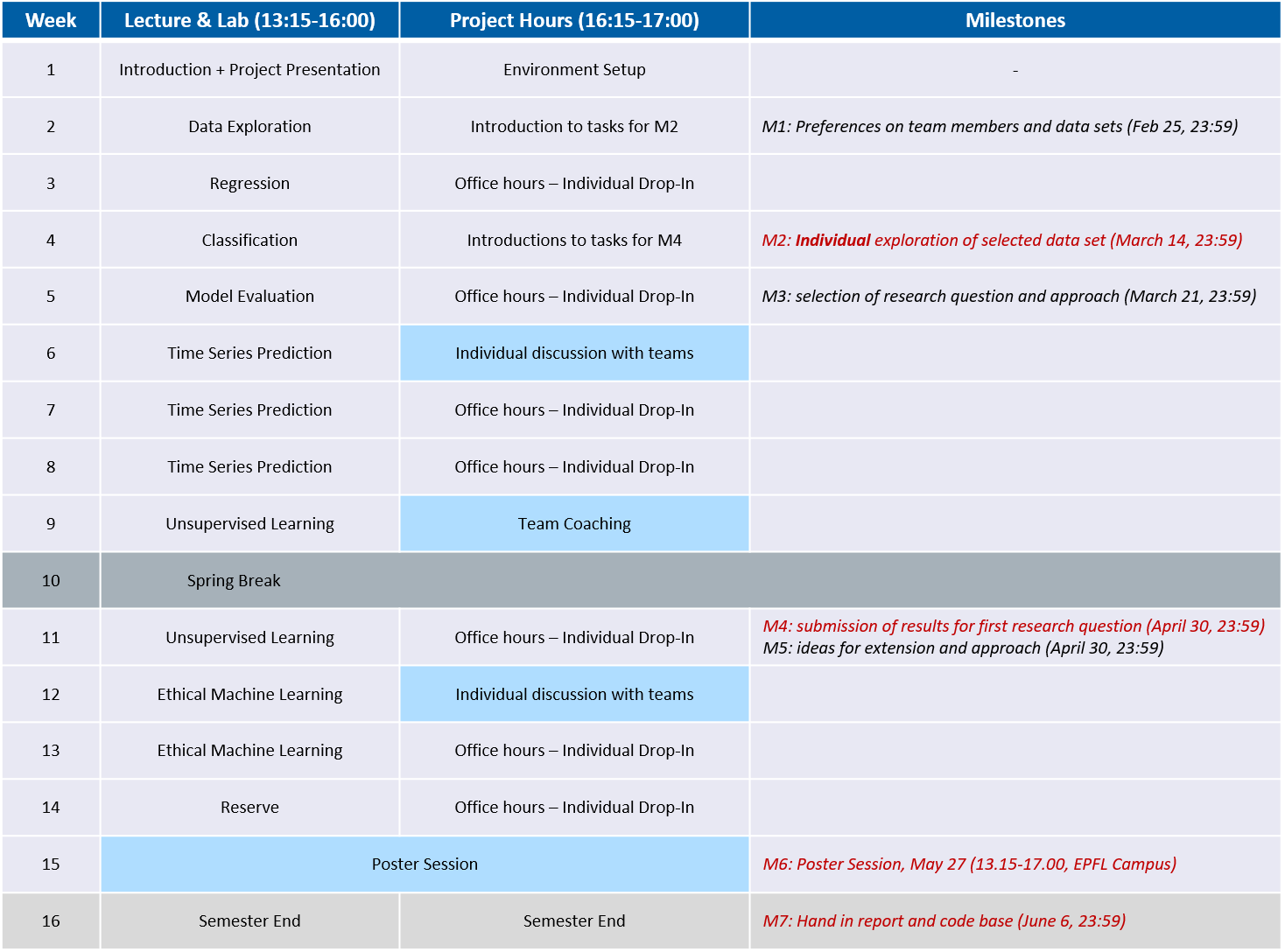
Course Content
The lecture slides, demo notebooks, and student notebooks will be uploaded every week to our GitHub repository.
Course GitHub Repository: https://github.com/epfl-ml4ed/mlbd-2025/
Lecture recordings (from 2022)
In-class activity feedback/questions
Grading
- 50% Project: teams of 3 people. 15% individual exploration (M2), 25% supervised learning (M4), 20% presentation (M6), 40% final results (M7)
- 50% Final Exam (Exam Session): individually, at the laptop. Mix of conceptual and coding questions.
Feedback
We are fully committed to providing the best possible version of the course and we appreciate all constructive feedback.
We are looking forward to reading your comments and improving based on them.
Other Useful Resources
Final Exam 2023
Announcements and Class Questions
- Announcements (Forum)
- Q&A Forum (Forum)
- Teammates Forum (Forum)
- Announcements (Forum)
- Q&A Forum (Forum)
- Teammates Forum (Forum)
Exam Preparation
The exam is composed of two parts:
1) Conceptual questions and
2) Programming exercises
- [Solutions] MLBD 2022: Conceptual Questions (File)
- [Solutions] MLBD 2022: Coding Questions (File)
- Coding questions 2022 (URL)
- Daylight Saving Quiz - Solutions (File)