Communications project
COM-304
Media
About This Class
Welcome to COM-304!
Attendance:- Lectures: The location is CE12; there will be 4 lectures in total that you need to attend. There will be other, physical or recorded, lectures based on the track you pick.
- Project Sessions: You can come to INM200, INJ218, INF019 (Course Info for exact timing). These sessions are mainly meant for you to ask questions, so you are not required to be present. TAs and student assistants will be present on Thursdays and Fridays between 10:00 and 12:00.
- Instructors: Prof. Amir Zamir (amir.zamir@epfl.ch) and Prof. Haitham Hassanieh (haitham.alhassanieh@epfl.ch)
- Doctoral TAs: Roman Bachmann, Zhitong Gao, Aoyu Gong, Muhammad Uzair Khattak, Jiachen Lu, Arman Maghsoudnia, Hailan Shanbhag, Kunal Pratap Singh, Jason Toskov, Mingqiao Ye
Course Summary
The primary goal of this course is to give you hands-on experience with solving real-world challenges by working in teams to program different hardware platforms and ultimately build your projects.
The overall structure of the course will consist of a few introductory lectures at the beginning to introduce the project and research areas in wireless communication/sensing, foundation models, and robotics. You will have time to go through the background material needed for the course and get familiar with the hardware and sensor platforms. You will then organize into groups of 3 and propose a project using one of the provided hardware platforms with the aid of the course staff. Finally, you will design, build, and present your project.
Project Topics and Platforms
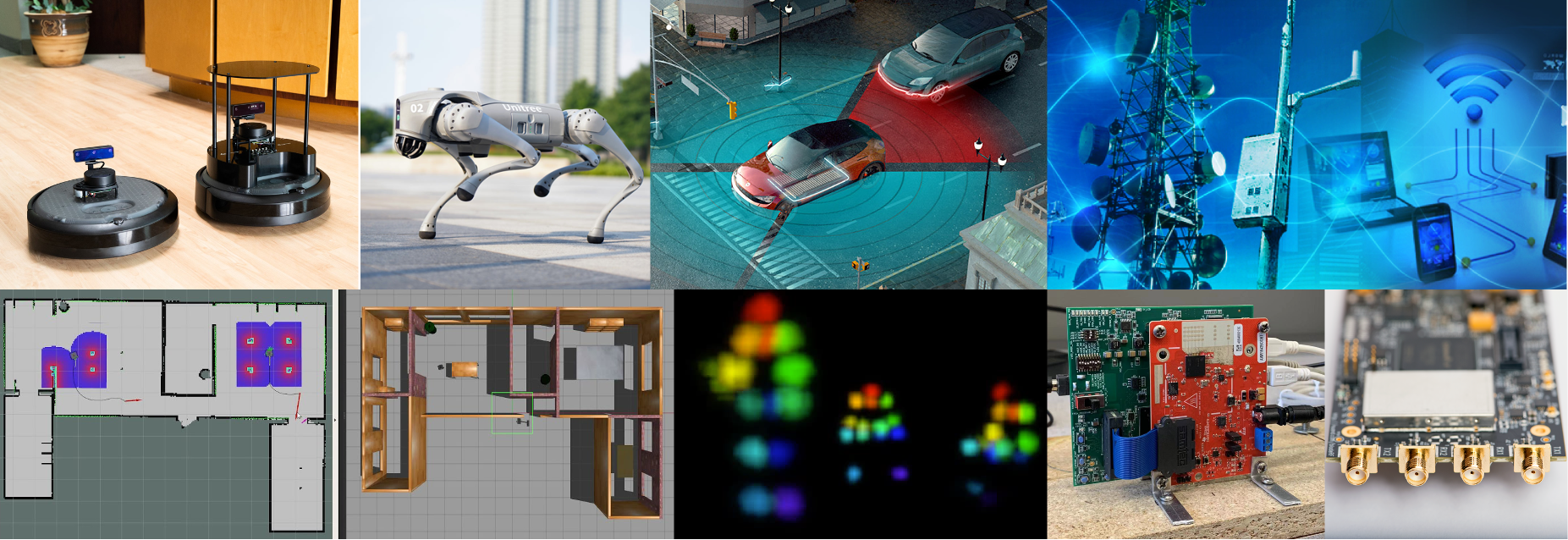
There are four options for a project. For each project, the corresponding page contains a detailed description of the project, necessary guidelines, studying material, and homework to be completed.
- Robotics:
- Project page: https://github.com/EPFL-VILAB/com-304-robotics-project
- Platforms: TurtleBot 4 Lite (primary), Unitree Go2, and MyAGV (1 of each available, not fully supported)
- Software Radios:
- Project page: https://github.com/samhy99/COM-304-BladeRF
- Platform: BladeRF software-defined radios
- Radars:
- Project page: https://github.com/hailanzs/COM-304-Radars
- TI millimeter-wave radars
- Foundation Models:
- Project page: https://github.com/EPFL-VILAB/com-304-FM-project
- Platforms: LLMs, VLMs, LMMs
Prerequisites
Having a signal processing, communications, data science, machine learning, or AI background will be useful but not required as many resources in the forms of videos, tutorials, and background reading material will be provided.
Expected student activities
- In regard to the course project, students need to pick the topic for their project and follow the project-specific instructions, demonstrating continuous progress throughout the semester, providing a final written report, and presenting the project.
- In regard to the studying material, students need to study the corresponding material and complete two individual homeworks for the project they picked (specified in the corresponding project pages listed above).
Assessment methods
- 25% Individual Graded Homework
- 10% Individual Weekly Progress Meeting
- 15% Project Proposal
- 10% Project Progress Report
- 40% Final Project: Demo, Presentation, & Report.
Syllabus & Schedule
Introductory Lectures
- Slides: Lecture 1 Part 2 (URL)
- Video Lecture 1 (URL)
- Slides: Lecture 2 (URL)
- Video Lecture 2 (URL)
- Slides: Lecture 3 (Transformers) (URL)
- Slides: Lecture 4 (Robotics and Reinforcement Learning) (File)
Tutorials
- Millimeter Wave TI Radar Tutorial (URL)
- BladeRF Software Radio Tutorial (URL)
- ROS2 & Turtlebot4 Tutorial (URL)
- SCITAS Tutorial (URL)
Background Lectures & Reading Material
Homework 1
- Wireless Communications: Modulation Schemes HW (URL)
- Wireless Communications: Modulation Schemes HW Folders and Files (Folder)
- Radar Imaging HW 1 (URL)
- ROS2 & Turtlebot4 (Robotics HW 1) (URL)
- Pytorch Tutorial (Foundation models HW 1) (URL)
Homework 2
- Wireless Communications: OFDM HW (URL)
- Wireless Communications: OFDM HW Folders and Files (Folder)
- Radar Imaging HW 2 (URL)
- Reinforcement Learning & Habitat (Robotics HW 2) (URL)
- 4M Tutorial (Foundation models HW 2) (URL)
Project Guidelines
- Robotics Project Guidelines (URL)
- Communications & Sensing Project Guidelines (File)
- Foundation Models Project Guidelines (URL)