Advanced energetics
ME-451
Media
AE
06.10.2023, 14:47
AE
06.10.2023, 14:47
AE
06.10.2023, 14:47
Advanced energetics introduction to Course and Project
06.10.2023, 17:14
Advanced energetics introduction
06.10.2023, 17:14
Energy Bill
06.10.2023, 17:18
energy bill and exergy
06.10.2023, 17:18
Process performance
06.10.2023, 17:20
energy bill and exergy
06.10.2023, 17:20
Exergy
06.10.2023, 14:04
energy bill and exergy
06.10.2023, 14:04
DTmin concept
27.10.2023, 17:58
DTmin optimisation theory - October 23rd 2023, 2:15:06 pm
27.10.2023, 17:58
Investment estimation
27.10.2023, 18:01
DTmin optimisation theory - October 23rd 2023, 2:15:06 pm
27.10.2023, 18:01
Annualising investment costs
27.10.2023, 18:02
DTmin optimisation theory - October 23rd 2023, 2:15:06 pm
27.10.2023, 18:02
DTmin calculation for heat exchangers
27.10.2023, 18:04
DTmin optimisation theory - October 23rd 2023, 2:15:06 pm
27.10.2023, 18:04
Composite_curves
27.10.2023, 18:06
DTmin optimisation theory - October 23rd 2023, 2:15:06 pm
27.10.2023, 18:06
MER- Minimum energy requirement
23.11.2023, 13:53
IPESE course - maximum heat recovery 2023, 2:17:39 pm
23.11.2023, 13:53
Penalizing heat exchangers
23.11.2023, 13:55
IPESE course - maximum heat recovery 2023, 2:17:39 pm
23.11.2023, 13:55
Mid-term and final exam information-AE- 2023
23.11.2023, 13:51
IPESE course - maximum heat recovery 2023, 2:17:39 pm
23.11.2023, 13:51
DTmin process and total area estimation
23.11.2023, 13:57
IPESE course - maximum heat recovery 2023, 2:17:39 pm
23.11.2023, 13:57
Defining_hot_and_cold_Streams
22.10.2024, 12:40
IPESE course -defijnig hot and cold streams November 13th 2023, 3:17:49 pm
22.10.2024, 12:40
Heat_exchanger_network_design
22.10.2024, 12:43
IPESE course - heat exchanger network design November 20th 2023, 2:15:48 pm
22.10.2024, 12:43
Path_and_loop_following
22.10.2024, 12:26
IPESE course - heat exchanger network design November 20th 2023, 2:15:48 pm
22.10.2024, 12:26
Plus_minus_principle
22.10.2024, 15:23
IPESE course -utility and plus minus November 27th 2023, 2:15:45 pm
22.10.2024, 15:23
Utility_integration_closing_energy_balance
22.10.2024, 15:25
IPESE course -utility and plus minus November 27th 2023, 2:15:45 pm
22.10.2024, 15:25
MILP_optimization_utility_integration
22.10.2024, 15:37
IPESE course - utilitry integration and exergy December 4th 2023, 3:21:51 pm
22.10.2024, 15:37
Utility_integration_exergy_analysis
22.10.2024, 15:50
IPESE course - utilitry integration and exergy December 4th 2023, 3:21:51 pm
22.10.2024, 15:50
AE
06.10.2023, 14:47
Advanced Energetics 2025-2026
Lectures + Project ( Monday: 14h15 - 19h00); Office hours (Thursdays 14h00 -16h00)
Instructor:
Prof. François Maréchal
Assistants:
Dr. Daniel Flórez-Orrego, Vibhu Baibhav, Pullah Bhatnagar, Federico Cazzulani
Introduction
The course is project-based: you will complete an energy efficiency analysis project in a group. Each week, we will provide you with the necessary theoretical background to solve your project's tasks. You will then receive tasks to be performed and synthesized within your group to write the final report for the project. The project will serve as the basis for the quizzes and the final exam. You can go through this GUIDE BOOK to know the different steps and milestones for your project.
This course consists of the following sections:
- Lecture, where you learn the theoretical concepts needed to handle the problems in the project.
- Quiz, during the semester five quizzes are planned to help you understand the theories (the exact date of each quiz is in the planning table below).
- Project session, where you will work on your project and interact with Prof. Maréchal and TAs if you have any questions.
- M1: Mass and energy balance of the CIP unit, energy bill calculation.
- M2: Minimum energy requirement and heat exchange network design.
- M3: Heat pump introduction and Utility integration in the energy system.
- M4: Exploring Synergy with the Dairy process, Reporting Symbiosis benefits
- M5: Valorization of waste product (Literature review) and reporting the benefits
TA's availability
TAs are available on Mondays during the allocated hours.'Office' hours will take place on Thursdays. If a group would like a session, a message requesting it should be sent at least the day before with a list of questions/doubts. Last minute questions will not be answered during Office hours.
Grading
The evaluation of your work includes three sections:
- Project report (50%)
- Report review (15%). Comments: you are required to review the report of one other group and write a peer review on how they can improve their work.You will receive the group's report at the end of Semester (W4 Dec'25) and will have to submit your review file before the start of exam session (W2-W3 Jan'26)
- Quizes (10%). Comments:4 distributed across the semester.
- Written exam - required (25%), where you will be asked to explain the methods and tools you used to complete the different tasks of the project.
| Sections | Weights | Grade (example) |
|---|---|---|
| Project report (with contribution evaluation) | 50% | 5.00 |
| Report review | 15% | 5.25 |
| Quizzes | 10% | 5.75 |
| Written exam | 25% | 4.00 |
| Total | 100% | 4.86 |
Planning
| Week | Planning for Lecture | Planning for Projects Session | Milestone/Quiz | |||
|---|---|---|---|---|---|---|
| 1. 08.Sep - 12.Sep |
|
|
|
|||
| 2. 15.Sep - 19.Sep |
|
|
Milestone 0 (21 Sep):
|
|||
| 3. 22.Sep - 26. Sep (Break) |
|
|
||||
| 4. 29.Sep - 03.Oct |
|
|
Quiz 1 - Quarto, Mass and Energy balance and Energy bill Milestone 1 (05 Oct):
|
|||
| 5. 06.Oct - 10.Oct |
|
|
Quiz 2 - Maximum heat recovery and DT min | |||
| 6. 13.Oct - 17.Oct |
|
|
Milestone 2 (12. Oct):
|
|||
| 7. 21.Oct - 25.Oct (Break) | |
|||||
| 8. 27.Oct - 31.Oct |
|
Quiz 3- Heat exchanger network design and penalising heat exchanger Milestone 3 (26. Oct):
|
||||
| 9. 03.Nov - 07.Nov |
Materials/Presentations
|
|
||||
| 10. 10.Nov - 14.Nov |
|
Materials/Presentations
|
Quiz 4 - Utility integration |
|||
| 11. 17.Nov - 21.Nov |
|
Materials/Presentations
|
||||
| 12. 24.Nov - 28.Nov |
|
|
Milestone 4(24. Nov):
|
|||
| 13. 01.Dec - 05.Dec |
|
|
||||
| 14. 08.Dec - 12.Dec |
|
|
Milestone 5 (7. Dec)
|
|||
| 15. 15.Dec - 19.Dec |
|
|
Milestone 6 (19. Dec)
|
|||
| 16. 20.Dec - 11.Jan |
|
|
Milestone 7 (11. Jan) Peer review |
|||
| 17. 28 Jan |
|
Forum
During this course, we will be using Forum for all of the communications.
Quiz
You can find the quiz here
Flip classes
During the flip classes, questions are assigned to each group and should be answered in 1-2 min. You are free to split the questions within the group members. When it is your turn, connect to the zoom link here, share your screen and answer the question. You can stay at your table while answering the question.
Project materials
Each group will be assigned to one project and two main tools will be used for collaborative work (you DO NOT need to install them in your VMs, as they have been already installed by our IT experts):
The idea behind the report template is that, by updating it on a weekly basis, the final report is progressively assembled and corrections can be applied before the final version. All the templates are provided in the form of a git repository. Therefore, it is necessary to know the basic set up of git for this course.
USEFUL LINKS
Detailed project descriptions will be available here
The VMs are accessible using VMware Horizon on the server https://vdi.epfl.ch under the name STI-FM-cours-2025
Additional info:
Inside the 'useful material' folder you will find publicly available literature, in particular, papers, charts, etc.
Some of the mentioned useful references are books, which are not available for Moodle sharing. In particular Turton and Perry Handbook; the former is available up to the 4th edition, while the latter up to the 8th edition. Both are at EPFL library for request and consultation. Digital versions can be found though.
- Project groups (Group choice)
- Useful material (Folder)
- Rosmose tutorial (Folder)
- Guide Book (Folder)
- Turton (File)
Lectures
Lecture notes are available here
- Project Introductions (Folder)
- Lectures : energy needs and energy bill (Folder)
- Lectures: Heat recovery, DTmin, investments (Folder)
- Lecture: Composite curves, MER, pinch analysis (Folder)
- Defining streams and Heat exhanger area estimation (Folder)
- Lectures: Heat exchanger design network (Folder)
- Plus-Minus principle (Folder)
- Lectures: Utility integration (Folder)
- Steam production working principle (URL)
- Air conditioner/Refrigeration cycle (URL)
- DWSIM model (Folder)
Report & Review section
Submission Section
Final report submission: Due Date - (19.12.2025). You only need 1 submission per group.To submit your report, wrap all your html files from the _book folder into a zip file.
Review submission: Due Date 11. January Only put your name and sciper on an extra (first) page. Do not put your name/sciper anywhere else in the document. Write a 2-4 pages review. Start with an introductive overview on the project and general recommendations on the report. Then, continue with more specific comments (try to group them by categories). Justify your comments and discuss the outcomes of the report with a critical thinking. Most important, be respectful and raise relevant feed-backs.
Good luck!!
- Conclusion of the course and recommandations for preparing the exam (File)
- How to conduct a peer review (URL)
- General guidelines for writing a scientific report (File)
Final Exam
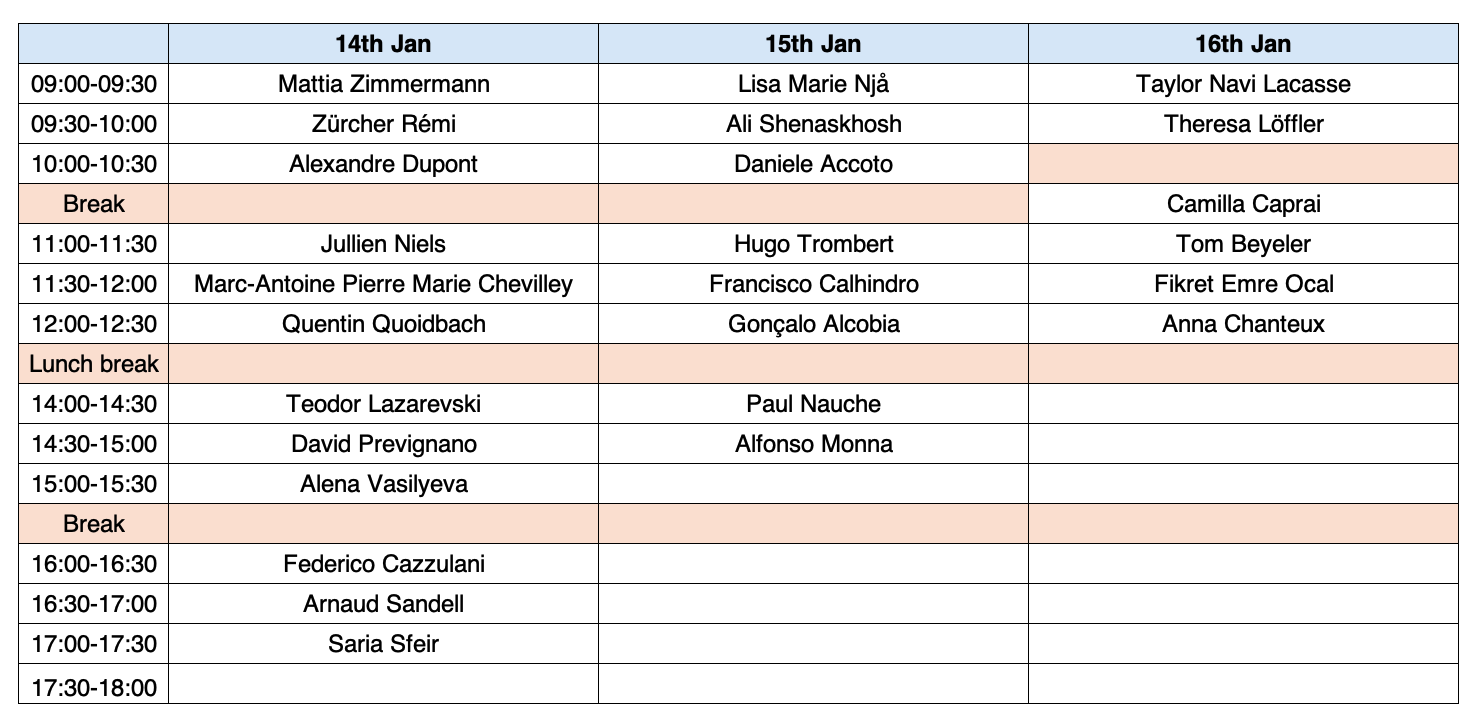
You will find below the schedule (updated) for your oral exam, if you have any concerns, please contact the TA as soon as possible
- The exam will take place in room ME A2 465 from the 14th to the 16th of January 2024.
- The exam will start with your short 3-minute talk about your project. Then prof. Maréchal will ask you questions on the theory of the course. Only prof. Maréchal will ask questions. The 2-3 other experts will only record and grade your answers.
- During the exam, you will have a screen with your own summary of your project (on Miro). You can also put some theory notes and equations on it to support your answers to the theory questions. A good advice is to avoid covering your summary with the whole course, since it usually disturb the explanation, make it unclear and make the student lost in the summary.
Useful materials
- General: Lecture notes (File)
- General: Cost annualisation (File)
- Energy conversion - course material (File)
- General information (Folder)
- Exercises and solutions (Folder)