Distribution and interpolation spaces
MATH-502
Media
Distribution and Interpolation spaces MATH-502
Assistant: Antonio Tirotta
Lectures
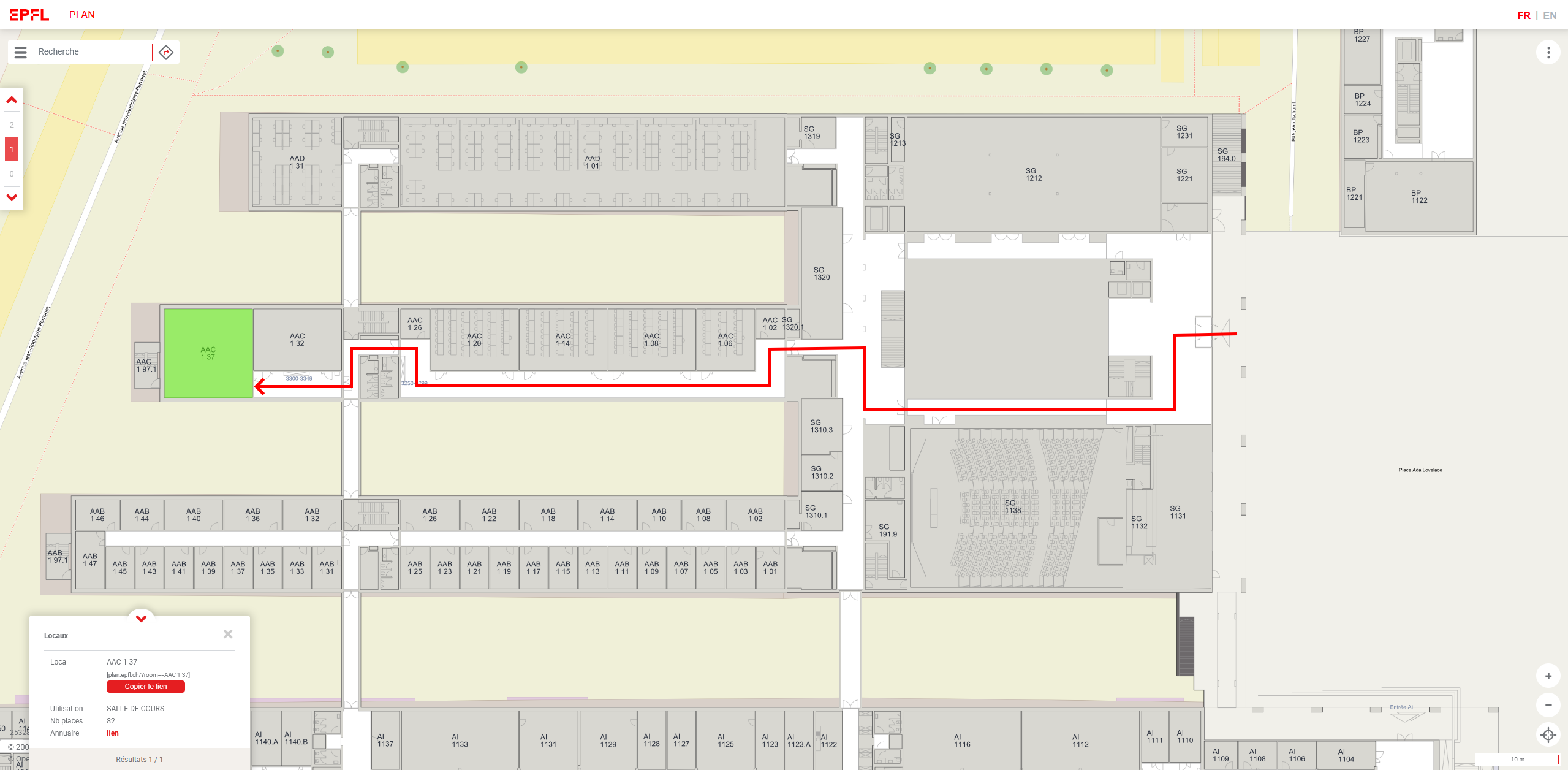
The lectures of the course will be held in person every Thursday morning from 10:15am to 12:00am in the room AAC 1 37.
Lecture notes will be updated every week and uploaded after the lecture at the following link.
Access plan to the lecture room.
Exercise Sessions
The exercise session will take place on Thursday afternoon between 13:15 and 15:00 (in the same room AAC 1 37).
The exercise session will have a ~30’ discussion, mainly of an exercise of the previous series or of the current one. This discussion may happen at the beginning or in the middle of the exercise session, depending on the topic to be discussed.
The rest of the time is devoted to Q&A. You can pose the questions directly or ask the assistant via chat. You can also enter a breakout room to discuss with a peer.
Exam
The date of the exam will be communicated later this semester.
Your individual schedule will be communicated in December.
The exam is an oral exam divided into two parts. First, the exam is given (the candidate will be able to choose one exercise amongst many) and the examinee has 30 minutes to prepare. After this delay, the oral exam starts and lasts for 30 minutes.
"Théorie des distributions," Laurent Schwartz.
"Analyse fonctionnelle. Théorie et applications," Haïm Brezis.
"Functional analysis, Sobolev spaces and partial differential equations," Haïm Brezis.
"Cours d'analyse. Théorie des distributions et analyse de Fourier," Jean-Michel Bony.
"Sobolev Spaces," Robert A. Adams and John J. F. Fournier.
"Elliptic Partial Differential Equations of Second Order," David Gilbarg and Neil S. Trudinger.
"Partial differential equations," Lawrence C. Evans.
"An introduction to Sobolev spaces and interpolation spaces," Luc Tartar.
"An introduction to harmonic analysis," Yitzhak Katznelson.
We covered the Hahn-Banach theorem and its proof and proved the Banach-Steinhaus principle. Next week, we will prove the two other main theorems of Banach and start introducing the notion of weak topology.
We finished the section on the three theorems of Banach and finished with Corollary 1.2.8 page 15. Next week, we will cover weak topology which will conclude the introductory chapter on Banach spaces. In two weeks, we will start distribution theory.
We introduced weak topology and stated (but did not proof) Banach-Alaoglu-Bourbaki's theorem on the compactness of the unit ball for the weak * topology. We introduced the first definitions of distributions.
We proved the Banach-Alaoglu-Bourbaki theorem and introduced the inductive limit topology on the set of compactly supported functions to justify the definition of distributions. Next week, we will start to cover systematically all properties of distributions (product, convolution, and later, Fourier transform).
We introduced the notion of distribution with compact support and proved the main properties of convolution (we finished p. 39 before giving the example of the Green's function of the Laplacian). In two weeks (next week is the Semester's break), we will finish the section on convolution and introduce the notion of Fourier transform for distributions.
27 October - 2 November
We finished convolution and introduced the basics of Fourier transform, recalling the basic properties of the Fourier transform (and a few proofs) and finished with Definition 2.7.8 page 45.
3 November - 9 November
We finished the chapter on distribution theory (for some computations of Fourier transforms of explicit functions, we only gave the strategy without all details of the proof), omitting the appendix. We started Chapter 3 on Sobolev functions and stopped after Definition 3.1.1.
10 November - 16 November
We restarted Chapter 3 from scratch and gave an alternative definition of Sobolev spaces without using distribution theory (this is the definition that one can find at the beginning of chapters 8 & 9 of Brezis' treatise). We covered density of smooth functions, composition, change of variable, and extension operators. We proved the existence of a continuous linear extension operator (by reflection) from a half-space into the entire space and stated the general result (Theorem 3.3.3). Next week, we will give the proof of Theorem 3.3.3 and prove Sobolev's inequality, which is the most fundamental result of the chapter. It shows that a distribution whose derivative belongs to $L^p$ is either an $L^q$ function (for some $q$ depending on $p$ and the ambient dimension $d$), or a Hölder-continuous function (it belongs to $C^{0,\alpha}$ for some $0<\alpha<1$ that only depends on $p$ and $d$).
17 November - 23 November
We proved the extension theorem and the Sobolev embedding theorem in super-critical dimension at least 2. We finished before Lemma 3.4.3 page 35. Next week, we will finish the proof of the Sobolev inequality for all dimensions and exponents. If time allows, we will introduce the Sobolev space of function that "vanish on the boundary" (in an appropriate sense).
24 November - 30 November
We finished the proof of the Sobolev inequality in all cases, explained how to apply the results of higher order Sobolev spaces, and stated the Rellich–Kondrachov compactness theorem page 69. Next week, we will introduce the space of Sobolev functions that vanish on the boundary, prove the structure theorem of the dual space, and if time allows, introduce fractional Sobolev spaces modelled on L².