Smart sensors for IoT
EE-594
Media
EE-594 Smart Sensors for IoT
14, Lecture 14 (22 December)
04.01.2022, 13:27
13, Lecture 13 (15 December)
04.01.2022, 13:26
12, Lecture 12 (8 December)
15.12.2021, 10:21
11, Lecture 11 (1 December)
06.12.2021, 16:54
10, Lecture 10 (24 November)
30.11.2021, 16:52
9, Lecture 9 (17 November)
22.11.2021, 08:52
8, Lecture 8 (10 November)
16.11.2021, 10:28
7, Lecture 7 (3 November)
04.11.2021, 07:50
6, Lecture 6 (27 October)
27.10.2021, 16:32
5, Lecture 5 (20 October)
22.10.2021, 12:14
4, Lecture 4 (13 October)
18.10.2021, 10:53
3, Lecture 3 (6 October)
06.10.2021, 13:11
2, Lecture 2 (29 September)
01.10.2021, 14:29
1, Lecture 1 (22 September)
26.09.2021, 20:39
Welcome to the course on Smart Sensors for the IoT
Summary
One of the basic function of an IoT node is to collect, process, store and eventually send the collected data to the cloud. Therefore, sensors and the related sensor interface are key components in the IoT node. Additionally, the IoT node is constrained to very limited space (or volume) and energy. Hence, the sensors and its related interface have to be highly miniaturized and very energy efficient.
This course starts with an introduction to the broad field of the IoT with a particular emphasis on the aspects that are relevant to sensing IoT nodes. It then focuses on the design of highly energy-efficient, integrated sensor interface, starting with modelling the most important sensors found for IoT applications. The various electronic circuits most appropriate to interface these sensors are then presented with a particular focus on power consumption and noise. The interface circuits include the front-end electronics and an analog signal conditioning circuit followed usually by and analog-to-digital converter (ADC).
Content
Part I (A.M. Ionescu) – 14 hours (2 x 7) – Energy efficient IoT sensors and technologies
1. Introduction: wearable technology and energy efficient autonomous smart systems2. Low power sensor technology
- Motion sensors: accelerometers, magnetometers, gyroscopes (MEMS solutions)
- Biosignals and biosensors: ECG, EEG, EMG, EO, blood pressure, pulse wave velocity, SpO2, pH, ions (Na+, K+, Ca2+), glucose, cortisol
- Gas and particle sensors for air quality and breath analysis
- Temperature sensors
- Emerging 2D and 1D nanomaterials for sensing
- Low power CMOS
- Flexible electronics
- Systems‐on‐flex: substrates and integration techniques
- 3D heterogeneous integration
- Energy harvesting from motion
- Energy harvesting from thermal gradients: thermo‐electrical‐generators (TEGs)
- Energy harvesting from light in indoor and outdoor conditions
- Energy storage and power management: super‐caps and thin film batteries.
- Smart patches and stamps – state‐of‐the‐art, promises, challenges
- Smart garments – state‐of‐the‐ art, promises, challenges
- Smart watches, smart glasses: Apple, Google, Samsung versus others
Part II (C. Enz) – 14 hours (2 x 7) - Electronic sensor interface for the IoT
7. Introduction to the IoT.8. Description and modeling of the most important sensors that are appropriate to the IoT from an energy consumption and noise perspective.
9. General structure of an electronic sensor interface, including front-end electronics, signal conditioning and analog-to-digital converter (ADC).
10. Basic front-end circuits for interfacing IoT sensors including their power and noise optimization.
11. Low-power and low-noise signal condition circuits (amplifiers, filters, sample-and-hold).
12. Low-power ADCs.
13. Examples of sensor interface electronics.
These topics will be presented according to the schedule given below.
Program
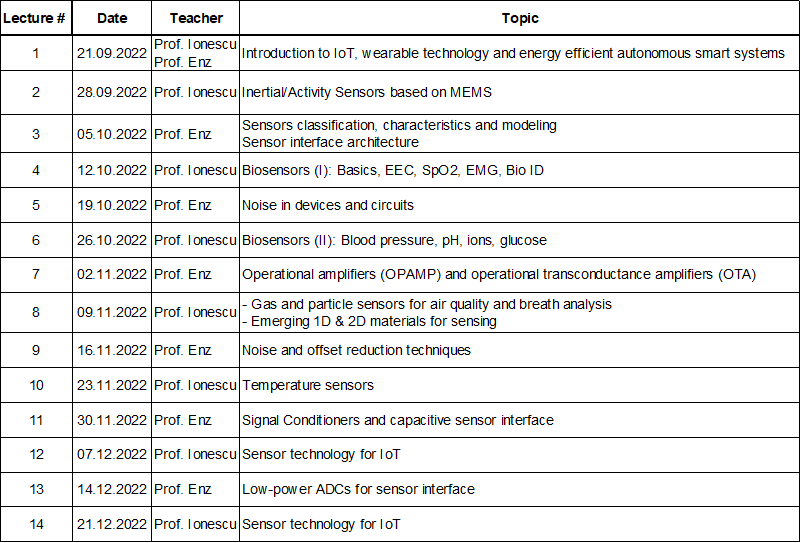
Schedule and timing (Autumn semester, 2021)
Every Wednesday, Course: 9:15-11:00, Exercise Session: 11:15-12:00, in room INR 113. For those who are not able to attend in person, the lecture will be broadcasted via zoom and they can join using this zoom link. The lectures will also be recorded and the video can be accessed on SwitchTube. The links to the videos of individual lectures are given below.
Resources
Books
- Enabling the Internet of Things – From Integrated Circuits to Integrated Systems, Massimo Alioto, Editor, Springer 2017.
- J. Fraden, Handbook of Modern Sensors, 5th edition, Springer, 2016.
- R. Pallas-Areny, J. G. Webster, Sensors and Signal Conditioning, 2nd ed., Wiley, 2001.
- J. G. Webster, The Measurement, Instrumentation and Sensors Handbook, CRC Press, 1999.
- W. Bracke, R. Puers, C. van Hoof, Ultra Low Power Capacitive Sensor Interfaces, Springer, 2007.
- J. M. Fiore, Operational Amplifiers and Linear Integrated Circuits, 3E.
- S. Franco, Design with Operational Amplifiers and Analog Integrated Circuits, 4th edition, Mc Graw-Hill, 2015.
- Johan Huijsing, Operational Amplifiers, 3rd ed., Springer, 2017.
- Johan F. Witte, Dynamic Offset Compensated CMOS Amplifiers, Springer, 2009.
Lecture 1 (20 September)
Introduction to the IoT
Video recording:
- Introduction to the IoT (C. Enz) (File)
- Introduct IoT Technology perspective - A. Ionescu 2022 (File)
- Introduction Sensors for IoT (Technology - AIonescu) -version 2021 (File)
- Exercises (Folder)
- Q&A on the exercises (20 September) (Forum)
Lecture 2 (27 September)
Sensor Classification and Characteristics (for home reading)
- Definitions and sensors classifications
Sensor characteristics
Noise in Devices and Circuits (Part 1)
- Introduction
- Random signals and noise
Main noise sources of circuit components
Video recording:
Lecture 3 (04 October)
Inertial MEMS sensors, Introduction to Biosensors, ECG sensing
Video recording:
Lecture 4 (11 October)
Noise in Devices and Circuits
- Noise models of basic components
Noise calculation in continuous-time (CT) circuits
Video recording:
Lecture 5 (18 October)
Biosensors (I): Basics, EEC, SpO2, EMG, Bio ID
Video recording:
- Lecture #4 - Biosensors & wearables new 2022 (File)
- Lecture #4 - old slides 2021 (File)
- Exercise (Folder)
Lecture 6 (25 October)
Operational Amplifiers
Contents:- OPAMPs fundamentals
- Basic OPAMPs configurations
- OPAMPs non-idealities (bandwidth, CMRR, PSRR, offset, linearity, noise,…)
- OPAMPs macro-models
- Instrumentation amplifiers
- RC-active filters
Operational transconductance amplifiers (OTAs)
Video recording:
Lecture 7 (1 November)
Biosensors (II): Blood pressure, pH, ions, glucose
Video recording:
https://api.cast.switch.ch/p/113/sp/11300/playManifest/entryId/0_57lasppb/format/url/protocol/https/flavorParamIds/6,7/video.mp4Lecture 8 (8 November)
Gas and particle sensors for air quality and breath analysis
Lecture 9 (15 November)
Noise and Offset Reduction Techniques
Contents:
- The Autozero (AZ) technique
The Chopper Stabilization (CS) technique
Video recording:
Slides:
Lecture 10 (22 November)
Temperature sensors
Video recording:
Slides:
Lecture 11 (29 November)
Signal Conditioners and Capacitive Sensor Interface
Contents:
- Signal conditioners for resistive sensors
Signal conditioners for capacitive sensors
Video recording:
Lecture 12 (7 December)
TBD
Video recording:
https://api.cast.switch.ch/p/113/sp/11300/playManifest/entryId/0_3sowzizp/format/url/protocol/https/flavorParamIds/6,7/video.mp4Lecture 13 (14 December)
Low-power ADCs for Sensor Interfaces
Contents:
- SAR ADCs
Incremental ADCs
Slides:
Lecture 14 (21 December)
Energy harvesting
Video recording:
Slides:
Extra Material
- Example of Written Exam - 2019/2020 (File)
- 2019/2020 Exam Solutions (Folder)
- Solutions QCM exam 2019-2020 (File)
- PH sensor - exercise example (File)
- 2023.01.17 Exam (File)
- Smart Sensors Exam 2023 - Solutions (File)
- Exam preparation + questions sensors (File)